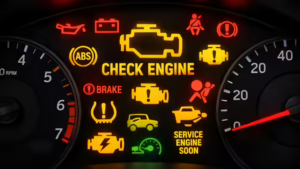
A warning light appearing on your dashboard can be confusing—especially when you’re driving a modern European car packed with advanced electronic systems.
Whether you drive a BMW, Mercedes-Benz, Audi, Volkswagen, Volvo or another European vehicle, dashboard warning lights are designed to tell you that something needs your attention.
Some warnings are simply reminders.
Others mean you should stop driving as soon as it is safe to do so.
The colour of the warning light can provide an important first clue:
- 🟢 Green/Blue: Usually indicates that a system or feature is operating.
- 🟡 Yellow/Amber: Usually means the system needs attention or should be checked.
- 🔴 Red: Usually indicates a potentially serious problem requiring immediate attention.
However, the exact meaning of a symbol depends on the vehicle manufacturer, model and system.
This guide explains the most common European car warning lights, what they generally mean, what you should do and when professional diagnostics may be necessary.
Quick Answer: What Do European Car Warning Lights Mean?
The most common dashboard warning lights include:
- Check Engine Light
- Engine Oil Pressure Warning
- Engine Temperature Warning
- Battery/Charging Warning
- Brake System Warning
- ABS Warning
- Tyre Pressure Warning
- Airbag Warning
- Traction Control Warning
- Electronic Stability Control Warning
- Steering System Warning
- Transmission Warning
- Diesel Glow Plug Warning
- DPF Warning
- AdBlue Warning
- Service Reminder
- Low Fuel Warning
Red warning lights generally require more urgent attention than yellow or amber warnings.
If a warning light is accompanied by smoke, overheating, severe engine noise, loss of braking performance or significant loss of power, stop safely and seek professional assistance.
Why Are Dashboard Warning Lights Important?
Modern European vehicles use multiple electronic control units and sensors to continuously monitor vehicle systems.
When the vehicle detects an abnormal condition, it may:
- Display a warning symbol
- Show a text message
- Store a diagnostic fault code
- Reduce engine performance
- Activate a protective operating mode
Ignoring warning lights can sometimes allow a small problem to develop into a much more expensive repair.
For example, a minor sensor or maintenance issue may be relatively straightforward to address, while continuing to drive with low oil pressure or severe overheating can potentially cause major engine damage.
1. Check Engine Light
Symbol: Usually an engine-shaped icon.
Common colour: Yellow/Amber
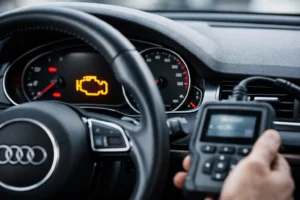
The Check Engine Light is one of the most commonly recognised dashboard warnings.
It means the vehicle’s engine-management system has detected a fault or abnormal operating condition.
Possible causes include:
- Engine misfire
- Oxygen sensor fault
- Airflow sensor problem
- Fuel-system issue
- Ignition problem
- Turbocharger/boost fault
- Emissions-related problem
- Throttle-body fault
- ECU-related issue
Can you keep driving?
It depends on how the car is behaving.
If the light is steady and the vehicle is operating normally, arrange a diagnostic inspection soon.
If the light is flashing, particularly with severe engine shaking or loss of power, stop driving when safe and seek professional assistance.
Important:
A Check Engine Light doesn’t automatically mean the engine needs replacing.
A diagnostic scan is needed to identify the underlying fault.
2. Engine Oil Pressure Warning
Symbol: Oil can
Common colour: Red
This is one warning you should take seriously.
An oil-pressure warning can indicate that the engine isn’t maintaining adequate oil pressure.
Potential causes include:
- Low engine oil
- Oil pump problems
- Oil-system faults
- Oil leaks
- Internal engine problems
- Other lubrication-system issues
What should you do?
Safely stop the vehicle as soon as practical.
If the warning remains on, don’t continue driving unnecessarily.
Insufficient lubrication can potentially cause severe engine damage.
3. Engine Temperature Warning
Symbol: Thermometer over waves
Common colour: Red
This warning can indicate that the engine temperature is too high.
Possible causes include:
- Low coolant
- Cooling-system leak
- Thermostat problem
- Water pump fault
- Radiator problem
- Cooling fan issue
Warning signs may include:
- Temperature gauge rising
- Steam
- Burning smell
- Reduced engine power
- Coolant warning
If the engine is overheating, safely stop and allow it to cool.
Never open a hot cooling system because pressurised coolant can cause serious burns.
4. Battery / Charging System Warning
Symbol: Battery
Common colour: Red
This warning doesn’t necessarily mean the battery itself has failed.
It can indicate a problem with the vehicle’s charging system.
Possible causes include:
- Alternator problem
- Battery issue
- Charging-system fault
- Drive belt problem
- Electrical connection issue
If the charging system stops working, the vehicle may eventually lose electrical power and stop running.
Arrange professional diagnosis rather than simply replacing the battery without testing.
5. Brake System Warning
Symbol: Circle with brake-related markings or an exclamation mark, depending on vehicle.
Common colour: Red
A brake warning may indicate:
- Parking brake engaged
- Low brake fluid
- Brake-system fault
- Hydraulic issue
- Other braking-system problem
If the warning remains on after releasing the parking brake, have the braking system checked.
Stop driving if:
- The brake pedal feels abnormal
- Braking performance is significantly reduced
- Brake fluid is leaking
- The vehicle behaves unpredictably during braking
Brake warnings should never be ignored.
6. ABS Warning Light
Symbol: “ABS” inside a circle or related symbol.
Common colour: Yellow/Amber
ABS stands for Anti-lock Braking System.
If the ABS warning appears, the vehicle may have detected a fault within the ABS system.
Possible causes include:
- Wheel-speed sensor problem
- ABS module fault
- Wiring issue
- Hydraulic component problem
- Electrical fault
The conventional braking system may still operate depending on the fault, but ABS functionality may be affected.
Arrange an inspection rather than assuming the warning will disappear by itself.
7. Tyre Pressure Warning
Symbol: Exclamation mark inside a tyre-shaped symbol.
Common colour: Yellow/Amber
This warning commonly indicates that one or more tyres have low pressure.
Possible causes include:
- Puncture
- Slow leak
- Temperature-related pressure change
- Incorrect tyre pressure
- Tyre pressure monitoring system fault
What should you do?
Check the tyre pressures as soon as possible.
If one tyre is significantly lower than the others, inspect it for damage or a puncture.
Driving with incorrect tyre pressure can affect:
- Handling
- Braking
- Tyre wear
- Fuel efficiency
8. Airbag Warning Light
Symbol: Person with a circle/airbag
Common colour: Yellow/Amber
This warning can indicate a fault within the Supplemental Restraint System (SRS).
Possible causes include:
- Airbag fault
- Seat-belt pretensioner issue
- Wiring problem
- Seat occupancy sensor
- SRS control-system fault
If the airbag warning remains illuminated, the system should be professionally diagnosed.
Because airbags are safety equipment, don’t ignore this warning.
9. Traction Control Warning
Symbol: Car with slipping wheels.
Common colour: Yellow/Amber
Traction-control systems help prevent excessive wheel spin.
The warning may appear when:
- The system is actively operating
- Traction control has been switched off
- A system fault has been detected
If the light remains illuminated unexpectedly, the system should be checked.
Possible causes include:
- Wheel-speed sensor fault
- ABS-related issue
- Traction-control fault
- Electrical problem
10. Electronic Stability Control Warning
Symbol: Skidding vehicle
Common colour: Yellow/Amber
Electronic Stability Control (ESC), sometimes called Electronic Stability Programme (ESP) depending on the manufacturer, helps maintain vehicle stability.
If the warning flashes briefly, the system may simply be actively intervening.
If it stays illuminated, there may be a system fault or the system may have been disabled.
A diagnostic inspection can determine the cause.
11. Steering System Warning
Symbol: Steering wheel
Common colour: Red or Yellow/Amber depending on vehicle and fault.
A steering warning may indicate a problem with the power-steering or steering-assistance system.
Possible causes include:
- Electric power-steering fault
- Steering-system electrical problem
- Low system voltage
- Steering sensor issue
- Mechanical steering problem
If steering becomes unusually heavy or difficult, stop driving when safe and seek professional assistance.
12. Transmission Warning Light
Symbol: Gear/cog or transmission-related symbol.
Common colour: Often Yellow/Amber or Red depending on the vehicle.
A transmission warning may indicate:
- Gearbox fault
- Transmission overheating
- Sensor problem
- Hydraulic issue
- Electronic control fault
- Low or degraded transmission fluid where applicable
You may also notice:
- Harsh gear changes
- Delayed shifting
- Gear slipping
- Difficulty selecting gears
- Reduced power
- Limp mode
Transmission warnings should be diagnosed promptly.
13. Diesel Glow Plug Warning
Symbol: Coil-shaped icon
Common colour: Yellow/Amber
This warning is mainly relevant to diesel engines.
The glow-plug light normally appears briefly when starting a diesel engine.
If it remains illuminated or flashes while driving, it can indicate a fault that requires investigation.
Possible causes vary by vehicle and can include issues involving:
- Glow plugs
- Engine management
- Fuel system
- Emissions system
- Sensors
A diagnostic scan can help identify the underlying problem.
14. Diesel Particulate Filter (DPF) Warning
Symbol: DPF/filter-related symbol
Common colour: Yellow/Amber
Diesel vehicles use a Diesel Particulate Filter to reduce particulate emissions.
A DPF warning may indicate that the filter requires regeneration or that there is a fault within the emissions system.
Possible symptoms include:
- Reduced engine power
- Increased fuel consumption
- Warning message
- Reduced-power mode
If the warning persists, professional diagnosis may be necessary.
Don’t repeatedly ignore DPF warnings.
15. AdBlue Warning
Symbol: AdBlue-related symbol or message
Common colour: Usually Yellow/Amber
Many modern diesel European vehicles use AdBlue/SCR systems to reduce nitrogen-oxide emissions.
An AdBlue warning may indicate:
- Low AdBlue level
- AdBlue-system fault
- SCR system issue
Some vehicles provide a countdown before a restart restriction occurs if the AdBlue supply is not replenished.
Always follow the vehicle’s displayed instructions and manufacturer requirements.
16. Service Reminder Light
Symbol: Spanner/wrench or service-related symbol
Common colour: Often Yellow/Amber
A service reminder doesn’t necessarily mean the car has developed a fault.
It can simply indicate that scheduled maintenance is due.
Depending on the vehicle, servicing may include checks or replacement of:
- Engine oil
- Oil filter
- Air filter
- Cabin filter
- Spark plugs
- Brake components
- Fluids
- Other maintenance items
Regular servicing is particularly important for complex European vehicles.
17. Low Fuel Warning
Symbol: Fuel pump
Common colour: Yellow/Amber
This is generally a reminder that fuel is running low.
Although it isn’t normally a mechanical fault, repeatedly driving with very little fuel isn’t recommended.
Refuel according to your vehicle’s requirements rather than relying on the warning light as a normal operating condition.
What Do Red, Yellow, Green and Blue Warning Lights Mean?
The colour can provide a useful first indication.
| Colour | General Meaning | What to Do |
|---|---|---|
| 🔴 Red | Potentially serious warning | Stop safely and investigate promptly |
| 🟡 Yellow/Amber | Attention or fault | Arrange inspection/diagnosis |
| 🟢 Green | System operating/status | Usually informational |
| 🔵 Blue | System/status indicator | Usually informational |
Important: These are general guidelines. Always check your specific vehicle’s owner’s manual because manufacturers use symbols and colours differently.
Which European Car Warning Lights Should I Never Ignore?
Some warnings deserve immediate attention, particularly when accompanied by abnormal vehicle behaviour.
High-priority warnings include:
- Red oil-pressure warning
- Engine overheating warning
- Serious brake warning
- Significant steering warning
- Charging-system warning with electrical problems
- Transmission overheating/fault warning
- Flashing Check Engine Light
- Any warning accompanied by smoke or severe mechanical noise
If the vehicle feels unsafe or braking/steering performance has changed significantly, don’t continue driving simply because the engine still starts.
Can I Drive With a Yellow Warning Light?
Sometimes.
A yellow or amber warning doesn’t automatically mean you must stop immediately.
However, you shouldn’t automatically ignore it either.
For example:
Tyre-pressure warning: Check your tyres promptly.
Check Engine Light: Arrange diagnostics, especially if performance changes.
ABS warning: Have the system checked.
Airbag warning: Arrange professional diagnosis because a safety system may be affected.
Transmission warning: Avoid delaying diagnosis, particularly if shifting becomes abnormal.
The warning + vehicle symptoms are more important than the colour alone.
What If Several Warning Lights Appear at the Same Time?
Don’t automatically assume that multiple systems have failed independently.
A single underlying problem can sometimes trigger several warning lights.
For example, an electrical or low-voltage problem may affect multiple vehicle control systems.
Possible causes include:
- Battery problems
- Alternator/charging faults
- Wiring issues
- Communication faults
- Sensor problems
- Control-module faults
A professional diagnostic scan can help determine whether the warnings are related.
Why Do European Cars Display So Many Warning Lights?
Modern European vehicles are highly computerised.
A typical vehicle can contain numerous control modules communicating with each other.
Systems may monitor:
- Engine performance
- Transmission
- Braking
- Steering
- Stability
- Airbags
- Tyres
- Emissions
- Battery/charging
- Climate control
This complexity means the vehicle can detect problems much earlier than older vehicles.
More warning lights don’t necessarily mean European cars are unreliable.
It means modern vehicles have more systems capable of detecting and reporting abnormalities.
Why Does a Warning Light Disappear After Restarting?
Some faults can be intermittent.
For example, a sensor may temporarily produce an abnormal reading and then return to normal.
Restarting the car may cause the warning to disappear from the dashboard.
However, the vehicle may still have stored the fault in its diagnostic memory.
Don’t assume:
“The light disappeared, so the problem is fixed.”
If the warning keeps returning, the vehicle should be diagnosed.
Can a Diagnostic Scan Tell You Exactly What Is Wrong?
A diagnostic scan is extremely useful, but a fault code is not always a complete diagnosis.
A code may identify:
- A monitored system
- An abnormal reading
- A communication problem
- A performance issue
The actual cause could be:
- Sensor
- Wiring
- Connector
- Mechanical component
- Vacuum leak
- Electrical supply
- Another related component
That is why experienced technicians combine diagnostic scanning with physical inspection and testing.
European Car Warning Lights: Quick Reference Guide
| Warning Light | General Meaning | Urgency |
|---|---|---|
| Check Engine | Engine/emissions fault | Medium–High |
| Oil Pressure | Possible lubrication problem | High |
| Engine Temperature | Engine overheating | High |
| Battery | Charging-system problem | High |
| Brake | Brake-system warning | High |
| ABS | ABS fault | Medium–High |
| Tyre Pressure | Low pressure/TPMS issue | Medium |
| Airbag | SRS fault | High |
| Traction Control | Traction system issue/status | Medium |
| ESC/ESP | Stability system issue/status | Medium |
| Steering | Steering-assistance fault | High |
| Transmission | Gearbox/system fault | High |
| Glow Plug | Diesel engine/emissions-related fault | Medium |
| DPF | Diesel particulate filter issue | Medium–High |
| AdBlue | Low level/system fault | Medium |
| Service | Maintenance due | Low–Medium |
| Fuel | Low fuel | Low |
Note: Exact symbols, colours and urgency can vary by make and model. Always consult your vehicle’s manual.
What Should You Do When a Warning Light Appears?
Follow this simple process.
Step 1: Don’t Panic
A warning light doesn’t automatically mean your car has suffered major damage.
Step 2: Look at the Colour
Red warnings generally require greater urgency than amber warnings.
Step 3: Read the Dashboard Message
Modern European cars often provide additional information alongside the symbol.
Step 4: Check How the Car Feels
Ask yourself:
- Is the engine running normally?
- Is the car losing power?
- Are the brakes normal?
- Is the steering normal?
- Is the engine overheating?
- Are there unusual sounds or smells?
Step 5: Check the Owner’s Manual
The exact meaning of a warning symbol varies by vehicle.
Step 6: Get Professional Diagnostics
If the warning persists or returns, arrange a professional inspection.
Common Mistakes European Car Owners Make
Ignoring a Warning Light
The biggest mistake is assuming that a warning will disappear permanently.
Continuing to Drive With a Red Warning
Red warnings can indicate potentially serious conditions.
Clearing Fault Codes Without Fixing the Cause
Resetting a warning light doesn’t repair the underlying problem.
Replacing Parts Based Only on a Fault Code
A diagnostic code isn’t always proof that the named component has failed.
Waiting Until the Car Breaks Down
Early diagnosis can sometimes prevent more extensive repairs.
How Much Does European Car Diagnostics Cost in Singapore?
Diagnostic costs vary depending on:
- Vehicle make and model
- Number of systems requiring testing
- Diagnostic equipment required
- Complexity of the fault
- Additional physical testing needed
A basic scan may identify stored codes, while a difficult intermittent fault may require more detailed testing.
For accurate pricing, the vehicle generally needs to be assessed based on the specific warning and symptoms.
Frequently Asked Questions
What is the most serious car warning light?
There isn’t one universal “most serious” symbol, but red oil-pressure, overheating, brake and significant steering warnings can indicate conditions that require immediate attention.
What does a yellow warning light mean?
A yellow or amber light generally means that a system requires attention or that a fault has been detected. The vehicle may still be driveable depending on the warning and symptoms.
Can I drive with the Check Engine Light on?
If the light is steady and the car is operating normally, arrange a diagnostic inspection soon. If it is flashing or accompanied by severe shaking, smoke or major power loss, stop driving when safe and seek assistance.
Why are multiple warning lights appearing on my BMW?
Multiple warnings can sometimes be caused by a single underlying issue, such as a battery, charging, wiring or communication problem. BMW-specific diagnostics can help identify the source.
Why is my Mercedes showing a warning light?
The exact cause depends on the warning symbol and model. Mercedes vehicles monitor many systems, so the dashboard message and diagnostic fault codes can provide important clues.
Why is my Audi showing a warning light?
It could indicate anything from scheduled maintenance to an engine, brake, electrical, transmission or emissions problem. The exact symbol and dashboard message should be checked.
Do warning lights always mean something is broken?
No. Some lights are informational or indicate that a feature is operating. Others are service reminders. Fault-related warning lights require further attention.
Can a warning light disappear by itself?
Yes, some intermittent warnings may disappear after the condition is no longer detected. However, a stored fault may remain in the vehicle’s diagnostic system, so recurring warnings should be investigated.
Can a diagnostic scan clear a warning light?
A scan tool may be able to clear a fault code, but clearing the code doesn’t necessarily repair the underlying problem. The cause should be diagnosed first.
When Should You Bring Your European Car to a Specialist?
Consider professional diagnostics if:
- A warning light remains illuminated
- The same warning repeatedly returns
- The car loses power
- Fuel consumption suddenly increases
- The engine runs roughly
- The transmission shifts abnormally
- Braking feels different
- Steering becomes heavier
- The vehicle overheats
- You hear unusual noises
- You smell burning or leaking fluids
Don’t wait for a dashboard warning to become a breakdown.
Regular servicing and early diagnosis can help identify developing problems before they become more serious.
Professional European Car Diagnostics in Singapore
Dashboard warning lights are your European car’s way of communicating with you.
The important thing is knowing which warnings require immediate attention and which require a scheduled inspection.
If your BMW, Mercedes-Benz, Audi, Volkswagen, Volvo or another European vehicle is displaying a warning light, ContiExpert can help identify the underlying issue through professional diagnostics and inspection in Singapore.
From engine and transmission warnings to ABS, airbag, electrical and emissions-related faults, getting the correct diagnosis is the first step toward the right repair.
A Warning Light Is Your Car Asking for Attention. Don’t Ignore It.
Contact ContiExpert for European car diagnostics and repair in Singapore.
Need Help Now?
WhatsApp ContiExpert with a photo of your dashboard warning light, your car’s make/model and the symptoms you’re experiencing.