One of the most worrying moments for any car owner is seeing the Check Engine Light (CEL) suddenly appear on the dashboard. Whether you drive a BMW, Mercedes-Benz, Audi, Volkswagen, MINI, Porsche, Volvo, Land Rover, or Skoda, this warning light should never be ignored.
In some cases, the issue may be relatively minor, such as a faulty sensor. In others, it could indicate a more serious problem affecting your engine, transmission, emissions system, or electrical components.
The good news is that the Check Engine Light doesn’t automatically mean your engine is about to fail. However, it does mean your vehicle has detected a fault that should be diagnosed as soon as possible.
In this comprehensive guide, we’ll explain:
- What the Check Engine Light means
- The difference between a solid and flashing warning light
- The most common causes
- What you should do immediately
- How professionals diagnose the problem
- How to prevent future warning lights
If you’re experiencing a Check Engine Light in Singapore, this guide will help you understand the issue before it becomes an expensive repair.
What Is the Check Engine Light?
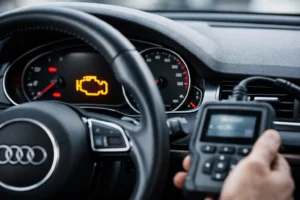
The Check Engine Light is part of your vehicle’s On-Board Diagnostics (OBD) system.
Modern European cars continuously monitor hundreds of sensors throughout the engine and electronic systems.
If the system detects an abnormal reading or malfunction, it stores a fault code and illuminates the Check Engine Light to alert the driver.
Think of it as your vehicle’s way of saying:
“Something isn’t operating as expected—it’s time for a professional inspection.”
Solid vs Flashing Check Engine Light
Understanding the type of warning can help determine the urgency.
Solid Check Engine Light
A steady warning light generally indicates that a fault has been detected but the vehicle may still be safe to drive for a short distance.
Common causes include:
- Faulty sensors
- Minor emissions issues
- Ignition system faults
- Fuel system problems
Although the vehicle may still drive normally, you should arrange a diagnostic inspection as soon as possible.
Flashing Check Engine Light
A flashing Check Engine Light usually indicates a more serious problem, such as an engine misfire.
Continuing to drive may cause damage to the catalytic converter or other engine components.
If the light is flashing:
- Reduce speed immediately.
- Avoid heavy acceleration.
- Stop driving if the vehicle runs poorly.
- Arrange professional assistance as soon as possible.
10 Common Causes of a Check Engine Light
1. Faulty Oxygen (O2) Sensor
The oxygen sensor measures the amount of oxygen in the exhaust gases and helps the engine maintain the correct air-fuel mixture.
Symptoms include:
- Increased fuel consumption
- Rough idling
- Reduced engine performance
- Higher emissions
Replacing a faulty sensor restores engine efficiency.
2. Engine Misfire
An engine misfire occurs when one or more cylinders fail to burn fuel properly.
Possible causes include:
- Worn spark plugs
- Faulty ignition coils
- Fuel injector problems
- Ignition system faults
Misfires should be repaired promptly to prevent damage to the catalytic converter.
3. Faulty Mass Air Flow (MAF) Sensor
The MAF sensor measures the amount of air entering the engine.
A faulty sensor may cause:
- Poor acceleration
- Rough idle
- Reduced fuel economy
- Difficulty starting
4. Fuel System Problems
Fuel delivery issues can trigger the Check Engine Light.
Possible causes include:
- Dirty fuel injectors
- Fuel pump issues
- Fuel pressure problems
- Clogged fuel filter
Professional diagnostics can identify the exact fault.
5. Catalytic Converter Issues
The catalytic converter helps reduce harmful exhaust emissions.
Common symptoms include:
- Poor engine performance
- Loss of power
- Increased fuel consumption
- Sulphur or “rotten egg” smell from the exhaust
Ignoring catalytic converter issues can result in costly repairs.
6. Vacuum Leaks
Small cracks in vacuum hoses or intake components may allow unmetered air into the engine.
Symptoms include:
- Rough idle
- High engine speed
- Hesitation during acceleration
- Reduced fuel efficiency
7. Faulty Ignition Coils
Ignition coils generate the voltage needed for the spark plugs.
When they fail, you may notice:
- Engine hesitation
- Rough running
- Misfires
- Poor acceleration
8. Turbocharger Problems
Many modern European cars use turbocharged engines.
Turbo-related faults may include:
- Reduced engine power
- Whistling noises
- Increased exhaust smoke
- Poor acceleration
These issues often trigger the Check Engine Light.
9. ECU or Sensor Communication Faults
Modern European vehicles contain multiple electronic control units that communicate continuously.
If communication fails due to a faulty sensor, wiring issue, or ECU fault, the Check Engine Light may illuminate.
10. Transmission-Related Issues
In some BMW, Mercedes-Benz, Audi, and Volkswagen models, transmission faults can also trigger the engine warning light.
Symptoms may include:
- Hard shifting
- Gear slipping
- Reduced acceleration
- Limp mode activation
Common Symptoms That May Accompany the Check Engine Light
Depending on the fault, you may also notice:
- Rough idling
- Poor acceleration
- Engine vibration
- Increased fuel consumption
- Difficulty starting
- Engine stalling
- Unusual engine noises
- Smoke from the exhaust
- Transmission problems
- Reduced engine power
These symptoms help technicians narrow down the possible causes.
What Should You Do If the Check Engine Light Comes On?
Follow these simple steps:
Stay Calm
The warning light does not always indicate a major engine failure.
Observe Your Vehicle
Ask yourself:
- Is the engine running smoothly?
- Are there unusual noises?
- Is there smoke?
- Is the vehicle overheating?
These observations provide useful information during diagnosis.
Avoid Aggressive Driving
Drive gently and avoid hard acceleration until the issue has been inspected.
Check for Other Warning Lights
If additional warnings appear, such as:
- Oil Pressure Warning
- Engine Temperature Warning
- Battery Warning
the issue may require immediate attention.
Schedule a Professional Diagnostic Inspection
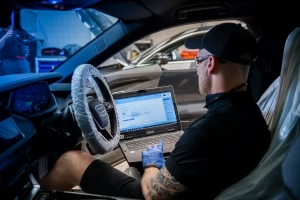
A diagnostic scan is the fastest and most accurate way to determine why the Check Engine Light has appeared.
How European Car Specialists Diagnose the Problem
Modern European vehicles require advanced manufacturer-level diagnostic equipment.
A typical diagnostic process includes:
- Computer diagnostic scan
- Reading fault codes
- Live sensor data analysis
- Engine performance testing
- Fuel system inspection
- Ignition system testing
- Visual inspection
- Road test
- ECU communication testing
Rather than simply clearing the warning light, experienced technicians identify and repair the underlying cause.
Why You Should Never Ignore the Check Engine Light
Ignoring the warning light can lead to:
- Reduced fuel economy
- Engine damage
- Transmission problems
- Catalytic converter failure
- Unexpected breakdowns
- Higher repair costs
Early diagnosis often prevents minor issues from becoming major repairs.
How to Prevent Future Check Engine Light Problems
Preventive maintenance significantly reduces the likelihood of warning lights.
Helpful tips include:
- Follow the recommended service schedule.
- Replace spark plugs on time.
- Repair oil and coolant leaks promptly.
- Use quality fuel.
- Replace worn sensors when necessary.
- Address unusual engine noises early.
- Perform routine diagnostic inspections.
- Never ignore small drivability issues.
Why Choose a European Car Specialist?
European vehicles feature sophisticated engines, electronics, and emissions systems that require specialised knowledge.
An experienced European workshop offers:
- Manufacturer-level diagnostic equipment
- Skilled technicians
- Genuine or OEM-quality replacement parts
- Accurate fault diagnosis
- Transparent repair recommendations
- Reliable workmanship
Choosing a specialist ensures the correct repair is carried out the first time.
Frequently Asked Questions
Is it safe to drive with the Check Engine Light on?
A solid warning light may allow limited driving, but the vehicle should be inspected as soon as possible. If the light is flashing or the engine is running poorly, avoid driving until the issue has been diagnosed.
Can the Check Engine Light turn off by itself?
In some cases, the light may switch off if the fault no longer occurs. However, the underlying issue may still be stored in the vehicle’s computer and should be checked.
Will a diagnostic scan tell me exactly what’s wrong?
A diagnostic scan identifies stored fault codes and provides valuable information, but technicians may perform additional testing to confirm the root cause before recommending repairs.
Can low engine oil trigger the Check Engine Light?
Low engine oil is more commonly associated with the oil pressure warning light, but engine-related issues caused by inadequate lubrication may also contribute to fault codes in some situations.
How often should I have my European car inspected?
Routine servicing and periodic diagnostic inspections help detect developing problems before they trigger warning lights or affect vehicle performance.
Why Professional Diagnostics Matter
Many drivers assume that clearing the Check Engine Light solves the problem. In reality, the warning light is only a symptom—not the cause.
Without identifying the underlying fault, the warning light is likely to return, and the issue may worsen over time. Professional diagnostics ensure that the actual problem is repaired rather than temporarily hidden.
Get Expert Check Engine Diagnostics at Volt Autocare
A Check Engine Light should never be ignored, especially in a modern European vehicle. Whether the cause is a faulty sensor, ignition issue, transmission fault, or engine management problem, early diagnosis can save you time, money, and unnecessary stress.
At Volt Autocare, we specialise in advanced diagnostics and repairs for BMW, Mercedes-Benz, Audi, Volkswagen, MINI, Porsche, Volvo, Land Rover, and other European vehicles. Using manufacturer-level diagnostic equipment and years of hands-on experience, our technicians accurately identify faults and recommend the right repair solution.
If your Check Engine Light has appeared, don’t wait for the problem to get worse. Contact Volt Autocare today to book a professional diagnostic inspection and keep your European car performing at its best.