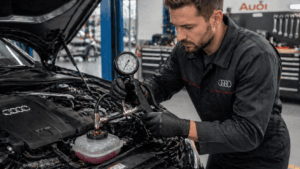
A smooth-running engine should feel consistent when you accelerate, idle and drive.
So when your BMW, Mercedes-Benz, Audi, Volkswagen or Volvo starts shaking, hesitating, losing power or showing a check engine light, an engine misfire could be one possible cause.
A misfire happens when one or more cylinders do not produce combustion as expected. The underlying problem can range from a relatively simple ignition component to a fuel, air, mechanical or electronic fault.
Ignoring a persistent misfire isn’t a good idea. Continued driving with certain engine faults can potentially lead to additional damage, particularly when a severe misfire is accompanied by a flashing engine warning light.
This guide explains what an engine misfire is, the common causes, symptoms to watch for, how European-car specialists diagnose the problem and when your vehicle should be inspected.
Quick Answer: What Causes a European Car Engine Misfire?
A European car engine misfire can be caused by problems with the ignition, fuel, air intake, engine timing, engine compression or electronic control systems.
Common causes include:
- Worn spark plugs
- Faulty ignition coils
- Fuel injector problems
- Vacuum or intake leaks
- Faulty airflow or pressure sensors
- Fuel-pressure problems
- Carbon or combustion deposits
- Timing-related problems
- Low engine compression
- ECU or electrical faults
The most common cause depends on the specific make, model, engine and symptoms.
A diagnostic scan followed by appropriate mechanical testing can help identify the actual cause rather than replacing parts based only on the symptoms.
What Is an Engine Misfire?
An engine misfire occurs when combustion in one or more engine cylinders does not happen as expected.
A petrol engine needs the right combination of:
Air + Fuel + Ignition + Compression + Correct Timing
If one of these elements is significantly affected, the engine may not produce normal power from that cylinder.
For example, a faulty ignition coil may prevent the spark plug from producing the required spark. A fuel injector problem can affect fuel delivery. An intake leak can change the air-fuel mixture.
The result can be a noticeable shake, hesitation, rough idle or loss of power.
10 Common Causes of European Car Engine Misfires
1. Worn or Faulty Spark Plugs
Spark plugs ignite the air-fuel mixture inside petrol engine cylinders.
Over time, spark plugs can become worn, contaminated or otherwise unable to operate correctly.
Possible symptoms include:
- Rough idle
- Engine hesitation
- Reduced acceleration
- Poor engine performance
- Increased fuel consumption
- Check engine light
- Intermittent misfire
Spark plug replacement intervals vary depending on the engine and manufacturer recommendations.
If your European car has a misfire, the condition and specification of the spark plugs should be checked.
2. Faulty Ignition Coils
Ignition coils generate the high voltage required by the spark plugs.
A failing ignition coil can cause a misfire in the cylinder it serves.
This can be particularly noticeable when:
- Accelerating
- Driving uphill
- The engine is under load
- The engine is cold or hot
Common symptoms:
Engine shaking + hesitation + check engine light
If the misfire follows a particular ignition component during appropriate diagnostic testing, the faulty component may need replacement.
3. Fuel Injector Problems
Fuel injectors control the delivery of fuel into the engine.
If an injector becomes clogged, restricted or develops an electrical or mechanical problem, the affected cylinder may not receive the correct amount of fuel.
This can result in:
- Rough running
- Misfire
- Poor acceleration
- Reduced power
- Increased fuel consumption
- Engine warning light
Injector problems can require more detailed testing than simply reading an engine fault code.
4. Vacuum or Intake Leaks
Modern European engines rely on carefully controlled airflow.
A damaged hose, seal or other intake component can allow air into the system that the engine management system isn’t expecting.
This can affect the air-fuel mixture.
Possible symptoms:
- Rough idle
- Engine hesitation
- Misfire
- Higher or unstable idle
- Check engine light
- Reduced performance
A visual inspection alone may not always locate an intake leak. Depending on the vehicle and symptoms, additional testing may be appropriate.
5. Airflow and Pressure Sensor Problems
Modern engines use various sensors to monitor conditions such as airflow and pressure.
Depending on the engine, problems involving sensors such as the MAF or MAP sensor can affect engine management.
Incorrect sensor information can contribute to:
- Poor acceleration
- Rough running
- Hesitation
- Misfire
- Check engine light
However, a sensor fault code does not automatically mean that the sensor itself is defective.
Proper diagnosis is important before replacing expensive components.
6. Fuel Pressure Problems
An engine requires adequate fuel pressure for proper fuel delivery.
Problems involving the fuel pump, pressure regulator, fuel filter or other components can affect fuel supply.
Possible symptoms:
- Engine misfire
- Poor acceleration
- Difficulty starting
- Loss of power
- Engine hesitation
- Stalling
If a misfire occurs mainly under heavy acceleration or higher engine load, fuel delivery should be one of the areas considered during diagnosis.
7. Carbon and Combustion Deposits
Some direct-injection engines can develop deposits over time.
Depending on the engine design and condition, deposits can contribute to airflow or combustion-related problems.
Possible symptoms may include:
- Rough idle
- Reduced performance
- Hesitation
- Misfire
- Poor throttle response
The appropriate cleaning or repair procedure depends on the specific engine and the confirmed cause.
8. Engine Timing Problems
The engine’s valves, pistons and ignition/fuel events must operate in the correct sequence.
A problem involving timing components or timing control can cause poor combustion and misfires.
Potential symptoms include:
- Rough running
- Loss of power
- Difficulty starting
- Engine warning light
- Unusual engine noise
- Multiple-cylinder misfires
Timing-related problems can be more serious than a simple spark plug or ignition coil issue, so they should be diagnosed promptly.
9. Low Engine Compression
An engine cylinder needs sufficient compression for combustion to occur properly.
Low compression can result from mechanical problems such as:
- Valve-related issues
- Piston or ring problems
- Head gasket problems
- Other internal engine faults
If ignition and fuel systems appear to be functioning correctly but a particular cylinder continues to misfire, compression testing or other mechanical testing may be necessary.
10. ECU or Electrical Problems
European vehicles contain sophisticated electronic control systems.
A misfire can sometimes involve:
- Wiring
- Electrical connections
- Sensors
- Actuators
- ECU-related faults
- Communication or control issues
This is another reason why replacing multiple components without diagnosis can become expensive.
A fault code should be treated as diagnostic information, not automatically as a parts-replacement instruction.
What Does a Misfiring European Car Feel Like?
A misfire can feel different depending on the cause and severity.
You may notice:
🚗 Rough idle
The engine feels uneven when the vehicle is stationary.
⚡ Hesitation
The engine briefly hesitates when you press the accelerator.
📉 Loss of power
The vehicle doesn’t accelerate as normally as it should.
🔄 Engine shaking
The vehicle or steering wheel may vibrate, particularly at idle.
🚨 Check engine light
The engine warning light may illuminate.
⛽ Increased fuel consumption
The engine may use more fuel than usual.
🛑 Stalling
In some cases, an engine problem can cause the vehicle to stall.
Why Is My European Car Shaking While Driving?
If your European car is shaking or jerking while driving, an engine misfire is one possible cause—but it isn’t the only possibility.
Other causes can include:
- Engine or transmission mounts
- Transmission problems
- Wheel or tyre issues
- Suspension components
- Fuel delivery problems
- Ignition problems
The timing of the vibration is useful information.
For example:
Shaking mainly while accelerating:
An engine or drivetrain issue may need investigation.
Shaking mainly while braking:
The braking system may be more relevant.
Shaking mainly at certain speeds:
Wheel, tyre or suspension issues may need to be considered.
A proper diagnosis is needed to distinguish between these possibilities.
What Does a Check Engine Light Mean During a Misfire?
A misfire can trigger the check engine light because the engine management system detects abnormal combustion-related conditions.
Steady check engine light
A steady light can indicate a fault that requires diagnosis.
You should arrange an inspection, particularly if the vehicle is also experiencing poor performance.
Flashing check engine light
A flashing engine warning light can indicate a more severe problem, including a potentially damaging misfire.
If the light is flashing and the engine is running very roughly, avoid unnecessary driving and seek professional assistance.
Can You Drive a European Car With a Misfire?
It depends on the severity and cause.
A minor intermittent issue may allow the vehicle to continue operating temporarily, but that does not mean it should be ignored.
Stop and seek professional assistance if you notice:
- Severe engine shaking
- Significant loss of power
- A flashing check engine light
- Strong fuel smell
- Unusual engine noise
- Severe hesitation
- Stalling
- Other signs of a serious engine fault
Continuing to drive with a significant unresolved misfire can potentially make the underlying problem worse or cause additional damage.
How Do Mechanics Diagnose an Engine Misfire?
A proper diagnosis usually involves more than connecting a diagnostic scanner.
Step 1: Understand the symptoms
The technician may ask:
- When does the misfire happen?
- Does it happen when cold or hot?
- Does it happen at idle?
- Does it happen during acceleration?
- Is the check engine light on?
- Has any recent repair been performed?
These details can help narrow down the possibilities.
Step 2: Diagnostic scan
The vehicle’s diagnostic system can provide fault codes and other information.
For example, the system may identify a cylinder-specific misfire.
But remember:
A fault code identifies an area requiring investigation; it doesn’t always identify the failed component by itself.
Step 3: Inspect ignition components
Depending on the vehicle, technicians may inspect:
- Spark plugs
- Ignition coils
- Wiring
- Electrical connections
Step 4: Check fuel delivery
Fuel pressure and injector operation may need to be evaluated.
Step 5: Check air intake
Technicians may inspect:
- Intake hoses
- Vacuum lines
- Sensors
- Throttle-related components
- Other air-management components
Step 6: Mechanical testing
If necessary, additional testing may include:
- Compression testing
- Leak-down testing
- Timing inspection
- Other engine-specific diagnostic procedures
The goal is to identify the root cause of the misfire, rather than simply clearing the warning light.
BMW, Mercedes-Benz and Audi Misfire Problems
Engine misfires can occur across many European brands, but the exact causes and diagnostic procedures depend on the individual vehicle.
BMW Engine Misfire
A BMW misfire may be associated with ignition, fuel delivery, air intake, sensors or other engine-management components.
Search terms commonly used by owners include:
“BMW engine misfire Singapore”
“BMW shaking while driving Singapore”
Mercedes-Benz Engine Misfire
Mercedes-Benz engines can experience ignition, fuel, air-management, sensor or mechanical issues that may contribute to misfires.
Owners may search for:
“Mercedes engine misfire Singapore”
“Mercedes shaking engine Singapore”
Audi Engine Misfire
Audi misfires can involve ignition, fuel, intake, sensor, timing or mechanical issues depending on the engine.
Common searches include:
“Audi engine misfire Singapore”
“Audi engine shaking Singapore”
The important point is that the same symptom doesn’t necessarily mean the same failed component across different models.
How Much Does European Car Misfire Repair Cost in Singapore?
There isn’t one fixed price for repairing an engine misfire.
The cost depends on what is causing the problem.
For example, the repair could involve:
- Spark plugs
- Ignition coils
- Fuel injectors
- Sensors
- Intake components
- Fuel system components
- Electrical repairs
- Timing components
- Internal engine repairs
The vehicle model, engine, parts required, labour and diagnostic complexity can all affect the final cost.
For this reason, it is better to diagnose the misfire first rather than assuming that a particular part needs to be replaced.
How to Prevent European Car Misfires
You cannot prevent every engine fault, but good maintenance can help identify problems early.
Follow the recommended service schedule
Regular servicing helps identify worn or deteriorating components.
Replace spark plugs when required
Don’t continue using spark plugs beyond the manufacturer’s recommended service interval.
Pay attention to warning lights
A check engine light should not be ignored simply because the car still drives.
Don’t ignore small symptoms
Hesitation, rough idle or occasional shaking can be early signs of an engine problem.
Use appropriate replacement parts
The correct component specification matters, particularly for European engines with sophisticated engine-management systems.
European Car Misfire: Symptoms vs Possible Causes
| Symptom | Possible Causes |
|---|---|
| Rough idle | Spark plugs, coils, injectors, intake leak |
| Shaking while driving | Misfire, drivetrain or other mechanical issue |
| Loss of power | Ignition, fuel, air, turbo or mechanical issue |
| Hesitation | Ignition, fuel or airflow problem |
| Flashing check engine light | Potentially severe misfire |
| Poor acceleration | Fuel, ignition, airflow or mechanical issue |
| Increased fuel consumption | Combustion or fuel-system problem |
| Difficult starting | Fuel, ignition, compression or timing issue |
| Stalling | Fuel, ignition, airflow or electronic problem |
| Single-cylinder misfire | Ignition, injector, compression or related fault |
Important: These are possible causes, not a diagnosis. The same symptom can have several different causes.
Why Professional European Car Diagnostics Matter
A misfire can sometimes be caused by a relatively straightforward component.
But replacing parts based only on symptoms can lead to unnecessary expense.
Professional diagnostics can help determine:
What is happening → Which cylinder/system is affected → Why it is happening → What repair is actually required
This approach is particularly useful for modern European vehicles where mechanical and electronic systems work closely together.
Frequently Asked Questions About European Car Engine Misfires
What is the most common cause of an engine misfire?
Common causes include worn spark plugs, faulty ignition coils, fuel injector problems and air or intake issues. However, the actual cause depends on the vehicle and symptoms.
Is an engine misfire serious?
It can be. A mild intermittent misfire may have a relatively simple cause, while a severe or persistent misfire can indicate a more significant problem. A flashing check engine light and severe shaking require prompt attention.
Why is my European car shaking at idle?
A rough or shaking idle can be caused by an engine misfire, intake leak, fuel problem, ignition fault or other mechanical/electronic issue. Diagnosis is required to determine the cause.
Can bad spark plugs cause a misfire?
Yes. Worn or faulty spark plugs can prevent proper ignition and cause a cylinder to misfire.
Can a faulty ignition coil cause a European car to misfire?
Yes. A failing ignition coil can cause an ignition-related misfire, particularly on petrol engines using individual ignition coils.
Can I drive with a flashing check engine light?
A flashing check engine light can indicate a serious fault, including a severe misfire. Avoid unnecessary driving and seek professional assistance.
Why does my car misfire only when accelerating?
A misfire that appears under acceleration or engine load can have several possible causes, including ignition, fuel delivery, boost/airflow or mechanical problems. Additional testing may be needed to identify the cause.
Does a diagnostic scan tell you exactly what is wrong?
Not always. A diagnostic code can identify a system, condition or cylinder that requires investigation, but further testing may be necessary to identify the failed component.
Is Your European Car Misfiring?
If your BMW, Mercedes-Benz, Audi, Volkswagen or Volvo is shaking, hesitating, losing power or showing a check engine light, don’t simply clear the warning and continue driving.
The sooner the underlying problem is identified, the easier it can be to determine the appropriate repair.
🚗 Experiencing an Engine Misfire?
Contact ContiExpert through WhatsApp to discuss your European car’s symptoms and arrange a professional inspection.
WhatsApp CTA:
“Hi ContiExpert, my European car is misfiring/shaking and I would like to have it checked.”
[Contact ContiExpert →]
Link this CTA to your /contact-us/ page and make the WhatsApp button prominent.